
Hostile Environments – the launch

It’s day 7 of my week of blogging to celebrate the publication of Hostile Environments and today I’m mostly promoting the on-line Zoom launch which will be on Thursday night between 7 and 8pm UK time. I’ll put a link to the Eventbrite page where you can book tickets at the end of this blog. It’s free but you do have to book.

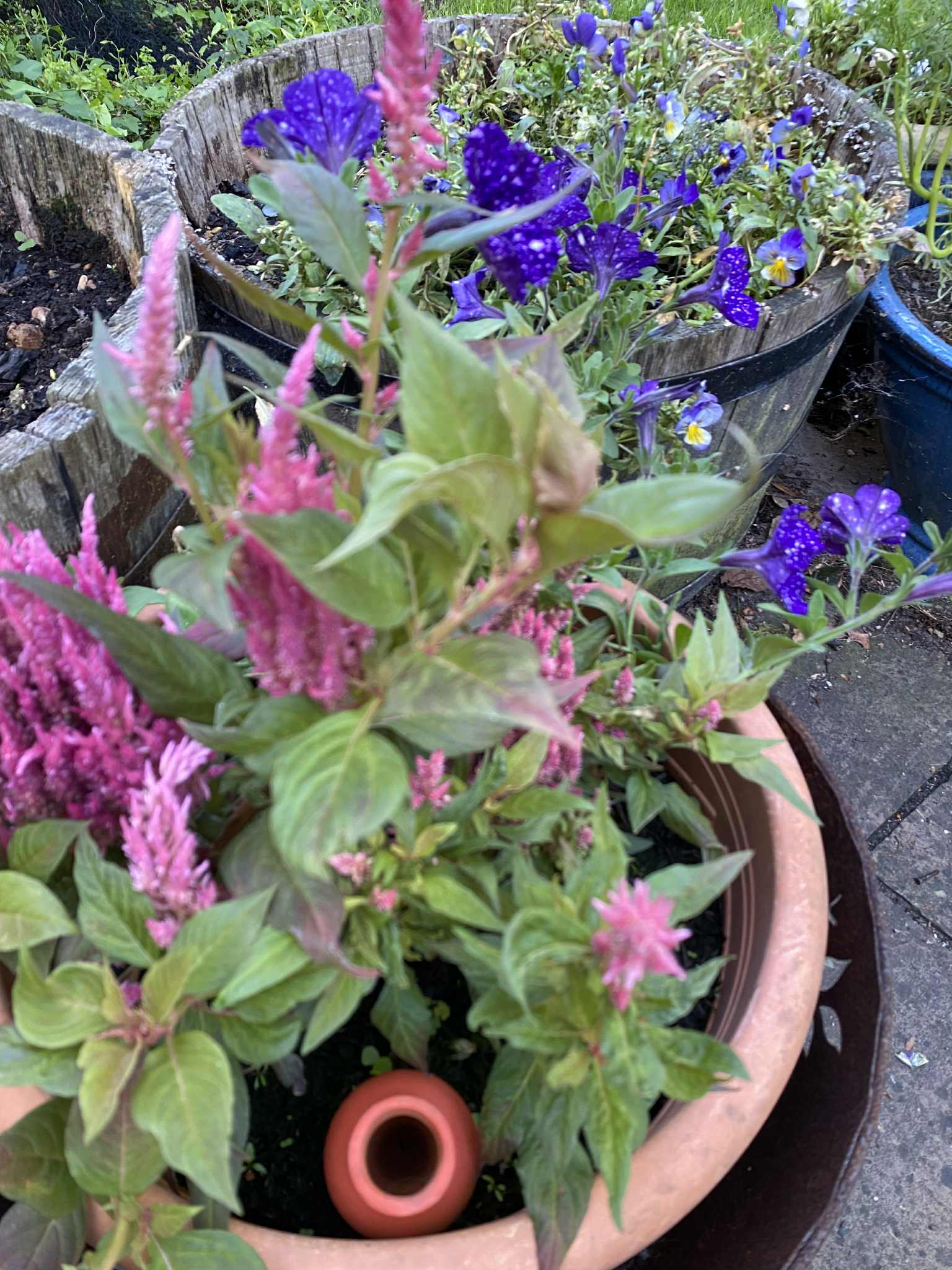
But first – plant of the day – Celosia argentea or plumed cockscomb, or silver cock’s comb, or Lagos spinach. I bought this one (pictured here) from Aldi when I was doing a shop earlier in the year. It was sitting outside in that heatwave we had in spring, looking almost dead and I felt sorry for it, so, not knowing what it was I bought it and brought it home, watered it and it grew and grew. I had no idea what it was but it’s easy to identify and turns out it’s considered an invasive weed in parts of India and china and is grown as a beloved veggie in west Africa where it’s served as boiled greens. It thrives in hot sun (if watered adequately) and is easy to grow – just the sort of plant I like then and perfect for my potager’s garden. I think I will always grow it from now onwards – for the gorgeous brightly coloured grassy flower heads, which are soooo lovely as much as for the leaves which do taste very like spinach. It’s a win win win plant – lovely to look at, great to eat and easy to grow. Wish writing stories came so easily. It’s funny because quite often folks are surprised that writing a teeny flash can take such a long time. To be fair, in my life BCW (before creative writing) I too, thought authors just sat down and wrote and there it was finished. I had no idea that writing was re-writing, editing, experimenting with what you’ve got, leaving everything alone to settle in a drawer, coming back to what you’ve written some time later, then maybe repeating that process all over again, and again, and maybe even again.

Mark Twain got it right – he once wrote to a friend, sorry about the long long letter but I didn’t have time to write a short one. And then sometimes stories do just pop out ready formed – you put pen to paper and ta-dah – a flash. For me this is very rare though because I like to experiment and pare things down, to do an Ursula Le Guin i.e. cut down the word count of a story by half – a really fab exercise to do – why not give it a go? It’s amazing when you do it for the first time, you learn a lot about editing, crafting and your own style of writing. Reet going to finish there today because you know – brevity. Will write more about the PhD application later in the week but in the meantime, here is the link for the launch on Thursday where I’ll be doing readings, a lighthearted generating writing ideas ten minutes, and answering questions from Northodox Press. Bring a brew or some fizz or whatever you fancy and spend an hour in cyberspace talking Hostile Environments. https://www.eventbrite.co.uk/e/hostile-environments-book-launch-tickets-1480973193689?msockid=1f3453cc4e1460930acc46d94f126195

When Shape and Blank Space are Storytelling Too

Day three of my week of blogs then to celebrate publication day for Hostile Environments (tomorrow) and today’s plant of the day is the globe courgette which you can see growing here in a pot on me patio outside the writing shed. I’ve never grown a cucurbit in a pot before – they usually go into the ground in beds as they get so big, and I’ve never grown globe courgettes before this year at all. Never saw one before this year in fact, and now they seem to be everywhere – happen someone hybridised them last summer and are knocking the seeds out cheap. The cucurbit family which includes pumpkins, cucumbers, melons and all manner of gourds is very easy to hybridise – in fact if you gather then keep the seeds from year to year, you never know what you’ll get the following summer. They have male and female flowers that are fertilised by flies that spread the pollen. No fertilisation and the fruits just stay small and drop off, fertilised and they swell into whatever. I planted these globe courgettes in a pot because I forgot to label them as seeds in the greenhouse and wasn’t sure what fruit they would yield until they started to appear and was pleasantly surprised when they became these lovely shiny deep green beauties. They are very good for stuffing and roasting – even the skin in crispy delicious done in the air fryer. What I didn’t expect when growing them, was the early advent of the wee cyclamen underneath. These gorgeous pinky petals usually only poke through much later in the year, bringing showers of pink and red and white to garden as the days start to darken. I’m thinking maybe the shadow cast by the huge green zucchini leaves tricked them into thinking it’s October and so out they popped – and they look so lovely there like a younger, sibling basking in the protective shade of their older sister – which lead me to thinking, on this book-publication-day eve, how stories can change depending on where they are placed inside a book and how they are set on the page. Flash fiction of all the prose forms is the one most aware of how it exists as a form or a shape I reckon. Not always though – sometimes a great flash is a great story written in the (brief) form of a story with a beginning, a middle and an end (in that order). But so often it’s not. So often flash sits on the page aware of the page – like a poem does, making its shape part of the story telling even. In recent times this sort of flash has been called hermit crab flash because – well you can see why – because hermit crabs borrow their shells – but I like the term hybrid flash better because quite often non-conformist flash fictions don’t borrow a shape , they are the shape. The storytelling, the beating heart of the story – its life and soul comes from the shape – it’s not an afterthought or tacked on afterwards. Here’s one of my flash fictions that does what I just described. How it sits on the page, the blank spaces in between the words even, the pause and moments of quiet, the emptiness are all part of the intrinsic storytelling. And so too is the juxtaposition of the form and story which at once jar against each other and meld together – a bit like the lovely cyclamen and the huge courgettes – strange but satisfying flower bed fellows. But before you read it – I just remembered that, yet again I’ve not mentioned that bloody PhD application thang I’ve been banging on about for three days now. Tomorrow it will have to be…

How To Keep The Hunger At Bay

By Jan Kaneen

  1. Preheat oven to 180 degrees then go pick apples. In the wet’s best, on the darkest day of autumn, when everything smells of mold and mushrooms and the garden looks like rust and cinders. But don’t let the fruit ruin waiting for perfection.
  2. Stand under gnarled branches catching raindrops, marveling at how young the skin on your palm looks, not like the windfallen wrinkles everywhere else.
  3. Place apples in appropriate receptacle. I use a trug made from sheets of birch. It’s got a long flat bottom so the apples lie side-by-side without bruising when I hurry down garden to get out of the weather.
  4. Wipe fruit carefully so skins shine like wintery cheeks, like Georgy’s used to when he came inside for a warm on snowy days and the stove was lit.
  5. Don’t peel. A little skin will give the edges a ruddy tinge, and anyway, it’s good for you – full of roughage and it makes your hair curl – least that’s what I always told him when he used to pull his face.
  6. Slice into cored crescents that look like rose petals and place into buttered tart dish. I arrange mine in circular swirls that coil inward and make a pattern that looks like forever.
  7. Make caramel by heating butter and sugar. Most recipes say not to stir but I do because that’s the bit he loved best – standing on his three-legged stool at the cooker in his Winnie-the-Pooh apron, watching the crystals dissolve into liquid gold, like alchemy.
  8. Add four pinches of cinnamon. One for mummy, one for daddy and two for Georgy, then a squeeze of lemon. An edge of sharpness is necessary to cut through the syrup.
  9. Pour over apples then take block of shop-bought pastry from fridge. This is a matter of preference of course, so feel free to adapt to personal circumstance, but forty-odd years of following this recipe has taught me life’s too short for homemade rough-puff.
  10. Roll thin and place on top of apples, tucking in edges like a child’s blanket, then bake for fifty minutes.
  11. As scent of caramelized apples creeps like yesterday into warm kitchen, pour a glass of something lovely and remember – when you planted the sapling a lifetime ago, when it meant nothing and you were so impossibly numb-and-sensitive-at-the-same-time you couldn’t feel anything though everything still managed to hurt – opening your eyes, birdsong, hearing your own name… and a year later when you finally scattered ashes round the reedy stem… and the year after that, harvesting the first crop.
  12. Smile or cry. It doesn’t matter which.
  13. Take tart from oven and cool, but not too much. Grief, hope, love, remembrance – all are dishes best served warm.
  14. Eat as many slices as you need, savouring every last bitter-sweet mouthful until you’re so tip-top full to the brim you think you’ll never be able to manage another bite.
  15. Take another bite.

Weeks Like These…

…don’t come along very often for writers of strange, surreal, non-conventional and not all that commercial fiction. That is to say weeks in which your third book is published, so going to blog every day till Sunday, by way of celebration.

Been thinking about the industry that is publishing a lot in the run up to Thursday (launch day for Hostile Environments) – and its a weird old business I reckon. Though I’m on my third book, I’ve not got an agent and to be fair I’ve never really tried to get one other than via entering stories into comps that agents might see. And the longer my agentless status has gone on, the more I’ve become totally fine about it because at the end of the day I don’t write to eat. If I did it might be different but I started writing 10 years ago to sort my head out and see if I could. And it really worked for me and my mental health which has made me super grateful and I find it proper strange that so many people in this weird society we live in, want to monetise everything, even creativity. It’s like nothing has a purpose without the wonga it generates, and loads of people I know quite well still ask how much I earn/expect to earn from my writing, what I’ve sold, what I’ve won prize-money wise. And I’m not gunna lie – when I first started writing, the prize winning was great fun, and vindication too – but the longer I’ve gone on, the more I just like winning to get my work read, not necessarily sold (though all prize money is very gratefully accepted). My new collection of dark short stories and flash fictions is never going to sell a million copies. There I’ve said it. It’s short fiction, and weird, unconventional short fiction at that. Agents always seem to want to know when they’re asking for pitches, where books would sit in bookshops and which best sellers they’re most like. Strange that something new and entirely different is never wanted. Not at first. I have no idea where Hostile Environments would sit on a book shelf in Waterstones other than in the short story or flash fiction section. Or maybe on a table with other titles by indie publishers. When my publisher, Northodox decided to publish my book, they knew they would not be retiring on the proceeds. They took it on because my words spoke to them, because they loved my stories and wanted to get them read. And that’ll do for me. I want to get my stories read too. In fact its super important to me that they do get read, because I don’t really think a story’s finished till its been shared with other minds. Flash fiction demands a lot of its readers – with its concision, brevity and implication. Flash readers have to really lean in and join metaphorical dots – so much so, a well crafted flash can mean one thing to one reader and something totally different to another, and it’s that meeting of minds that I love about being a writer of it. So you see unread flash fiction really is unfinished flash fiction to my way of thinking.

Also. This. Imagine that in 100 years someone finds one of my books in a charity shop book sale say, or cyber-mines it from a long dead website, or digs one up from a ruined library in the aftermath of a war we have not yet foreseen – and they read one of my stories and it fires their neurones and their brains spring into action making synaptic leaps and other connections – and though I will be long dead and my atoms will be scattered, my mind will have connected with another human being over swathes of time and from beyond the grave, just because I wrote some stories and Northodox had the presence of mind to publish them in print and digitally. People think quantum entanglement is mind-blowingly weird and wonderful – but so is reading and writing -i t’s sorcery, and time-travel and telepathy all at the same time.

Anyhoo, back on planet earth, last week, I did an interview with the folk at Northodox about writing and creating. Here’s the link if you fancy having a read https://www.northodox.co.uk/post/author-interview-jan-kaneen and if you do feel moved to pre order a copy of Hostile Environments all the deets are there.

But in the meantime, here’s me doing a reading of one of my flashes that I just recorded especially for this blog. It’s not from Hostile Environments as I explain on the vid, but as I’m going to post every day this week, thought I’d release some of my stranger flash fictions into the wild too. Here’s the link to where it appears online as text ,if you prefer https://theshortstory.co.uk/words-and-sayings-by-jan-kaneen/ and below is my recording which carries a trigger warning with ref to toxic societal gender assumptions and uses sayings that would cause offence in their usual contexts, but hopefully not in this one, though they might well still be shocking. Reet that’s it for Monday. See you tomorrow when I will talk about the new project I have started to pursue – applying to York St John to do a creative writing PhD. Until tomorrow then. Oh yes and If you were wondering about the pot of flowers at the start of this post. Going to do a ‘flower of the day’ each day here too. I love growing flowers and veggies as well as stories and today I’m celebrating teeny lobelia and how though they might be small, they bring humongous joy.