
As readers of my last blog might remember I’ve been writing a Flash Manifesto (womanifesto? proclamation? pronouncement?) Nah manifesto will have to do. I’ve been doing this because I’m doing a PhD by Creative Practice which involves writing a novella-in-flash and critical commentary about the use of space, statis and the blank page. But how can I describe what space is doing in and in between my flash fictions, (as well as what novella-in-flash is), if I can’t clearly state what flash fiction is in the first place?
Everyday definitions differ a lot despite the fact that flash is increasingly popular with writers, is taught at many unis as part of undergrad creative writing degrees and is offered by bazillions of writer’s workshops to fee-paying customers. And there are flash competitions galore to enter that charge for the privilege, so if money is changing hands in the world of flash, then surely there should be some sort of agreed starting point as to what it formally is. And by this I don’t mean rules, I mean a shared agreement about what it is to avoid misunderstanding and bad advice.
To illustrate this lack of clarity I did some internet searching using my default search engine set to AI mode. This Co-pilot AI bot which after all scans the infinite sea that is the world wide web, stealing from everything written about the topic then condensing it down into a few sentences should be able to provide a general overview that’s real, I thought. This is what is said when I asked it what is flash fiction? ‘Flash fiction is a very short, self-contained story that delivers a complete narrative in under 1,500 words, often focusing on a single moment, character, or idea. Despite its compact size, it retains all the essential elements of a traditional story: a plot, conflict, and a satisfying shift or twist.’ Well that’s a strong disagree from me.
Google in AI mode says, ‘Flash fiction is a style of extreme brevity, usually defined as stories under 1,000 words, and sometimes as short as a single sentence‘.
Flash Fiction is not even listed in the OED or Miriam Webster online dictionaries. Dictionary.com says, ‘Flash fictions are very short works of fiction that are typically no longer than a couple of pages and may be as short as one paragraph.’ The free dictionary by Farlex says ‘flash is a genre of fiction in which stories are characterized by extreme brevity.’
Wikipedia says (bless it’s cotton socks), ‘Flash fiction is a brief fictional narrative that still offers character and plot development. Some commentators have suggested that flash fiction possesses a unique literary quality in its ability to hint at or imply a larger story. Varieties are sometimes defined by word count, including the six-word story, the 280-character story (“twitterature“), the “dribble” (also known as the “minisaga“, 50 words), and the “drabble” (also known as “microfiction”, 100 words).
Not a right lot of agreement then, even as to size, and the Wiki description is the only one that hints flash might have qualitative characteristics, and may include more than one form of brief story. All this general lack of clarity and agreement is one of the reasons I decided to do this manifesto (well that and the suggestion made by one of my supervisors) and I have arrived at it by researching: online journals, comps, practitioner guides with scholarly intros; reading what few and far between scholarly discussions I can find in literary peer-reviewed journals; using my own 10 years worth of experience writing more than 300 published pieces of flash in many shapes and sizes, and seeing what other practitioners think.
To get numerical limits sorted first, I researched flash comps to see what they ask for in their submission criteria, and many ask for entries way over 1000 words, some even as much as 2000 and most offer no direction other than wordcount. I also looked at e-zines and story print magazines that ask for submissions of flash, and though most ask for stories below 1000 words, quite a few ask for stories (which they call flash) of up to 1500 words. I found one asking for flashes up to 2000 words. I have therefore decided to go with what Smokelong Quarterly, Stories Archive – SmokeLong Quarterly, and Bath Flash Fiction Award, Bath Flash Fiction Award | International Rolling Flash Fiction Competition say. These two platforms, the first a respected flash magazine and the second a respected competition, also offer flash information, training, workshops, craft advice, interviews with flash authors and many examples of flash of all shapes, sizes and lengths. Both are trusted, prestigious and expert, and both present flash as being stories of 1000 words and under. Also, to my mind, narratives above 1000 words feel too much in the vicinity of short story form to truly be flash fiction. That’s not to say there can’t be flash-like short stories just as there can be short story-esque flash fictions, but the cut off point of 1000 words feels right to me, and this is my flash manifesto – so there it is!
But what is the cut-off point in the other direction? How short can a flash get and still have narrative movement or at the very least imply a context in which narrative movement might happen? Well I reckon it’s six words. You can defo get, or imply narrative movement in 6 words. Here are some of my comp winning 6 word stories to show this.
‘New heart, new lungs, same addiction’, ‘Broken heart seeks builder for reconstruction, ‘One marriage, two relationships, three kids’.
I haven’t been able to do this in five words or less, and haven’t found any flashes on-line on in print that have five or less words. That’s wordcount sorted then. Flash fictions, are stories between 6 and 1000 words which tell a story that either has narrative movement or suggest a context in which narrative movement might happen. But what about the much more difficult to pin down and under-described qualitative characteristics of flash fiction?
Older expert, how-to guides don’t help much. The intro to My Very End of the Universe – five novellas-in-flash and a study of the form, says ‘Flash is characterised by, ‘Compression, immediacy and tension…the concision of poetry with the narrative tools of fiction,’ (Beckel and Rooney, 2028, E-reader location 120 of 2025). I can agree with most of that except for the immediacy thing because flash fictions, especially longer ones can span narrative eons, but even if I agreed with the whole statement, there’s much, much more to say. The Rose Metal Press Field Guide to Writing Flash Fiction (2009), published when the term ‘flash’ was not yet the default name for short-short fictions, seems to hold the notion that to try to define flash would somehow constrain and reduce it. The editor says in her introduction entitled, In pursuit of the short, short story. “‘Each drop encases its own separate note, the way each drop engulfs its own blue pearl of light.’ This description of rain, from Stuart Dybek’s story ‘Nighthawks’ is as close to a definition of flash fiction as I can personally offer. A successful flash enchants us, each small story successfully rendered, engulfing us for a brief moment – in a ‘flash’…in its own brand of light or truth. And the effects linger on, sometimes for decades. To offer a more complete, hard-edged definition is virtually impossible. In the end, a flash is just a story in miniature, a work of art carved on a grain of rice.” (Masih, 2008, pp. X1).
Randal Brown says in A Pocket Guide to Flash Fiction, ‘There’s no agreed-upon definition, except perhaps the idea that its very short,’ (Brown, 2012 pp1). Jane Roberts writing in Wales Arts Review in 2015 says ‘…it is futile to attempt to define the exact universal boundaries of flash; these are wide-ranging.’
Expert (and wonderfully talented) practitioners also seem to feel the struggle defining flash characteristics. Tanya Hershman writing in answer to the question, ‘What is flash fiction?’ in Litro Magazine said, ‘Well, I don’t know. Really. I write flash fiction. I read flash fiction. But I can’t say definitively what it is.’ Luisa Valenzuela says, ‘I usually compare a novel to a mammal…the short story to a bird or fish; the micro-story to an insect (iridescent in the best cases).’ Lyrical analogies like this are useful as they give a flavour of the effects of flash on the reader, but, I want to understand and describe the techniques, the nuts and bolts that give rise to these effects. I prefer Ben Myers description, at least as far as micro flash fictions are concerned, ‘A successful flash fiction is a seed, planted in the readers imagination, which once there should grow and flourish.’
A more recent, scholarly article published in January 2024 in New Writing Journal by Shelley Roche-Jacques says this, ‘The idea of flash fiction as a story in miniature is aesthetically pleasing and simple, but it does not quite get to the heart of the form. It is not the case, as Masih’s image suggests, that all the elements of the story exist on the page, shrunk down. I would suggest that different techniques and approaches are used in flash fiction – and that this necessary ‘drive for innovation’ is part of the form’s growing appeal.’
I totally agree with this. Innovation is a key driver in my own flash fiction and lots of flash I love. Maybe this is why that, as a form, it seems to defy definition because it’s always morphing, always pushing boundaries and doing the opposite of what it did last week – thus making pinning down flash fiction’s formal paradigms a very tricky business indeed.
In the context of all this shifting difficulty then, here is my first draft flash manifesto (silent trumpet fanfare/ quiet drumroll. I’m in the graduate research centre at York St John typing this so I need to be a wee bit quiet). As I said previously this manifesto has its roots in my practical experience of writing flashes of all lengths from 6-1000 words and from reading the books mentioned above, but also from reading shed loads of other flash fictions, from entering (and sometimes winning) loads of competitions, and also from perspectives offered in Nancy Stohlman’s, engaging book Going Short: An Invitation to Flash Fiction and Michael Loveday’s practitioner’s guide, Unlocking the Novella-in-Flash.
This manifesto is a starting point not a definitive answer and it will, I expect, grow and morph as my flash research progresses. To extend Dan Myers metaphor, it is more seed than sapling and more sapling than mature plant.
Jan’s First-Draft Flash Manifesto
1.Flash Fiction is an umbrella term for often formally different fictions of between 6-1000 words that are nearly always experimental in some way in terms of language, poetics, plot construction, on-the-page presentation, genre or character development.
2.Longer flash fictions between 500-1000 words are structurally often short, short stories that either conform to or experiment with Freytag’s pyramid and therefore have: initial exposition, rising action, climax, falling action and a denouement/resolution. As flash is inherently experimental this form may be treated in unusual and unexpected ways but narrative movement is defo part of the mix.
3.Briefer flash fictions below 500 words start to move away from short-story form the shorter they become, building character, plot and narrative momentum using techniques like: subtext; implication; controlled omission; compression; linguistic precision; figures of speech; resonant endings; formal experimentation; titles that reframe and morph; manipulation of white space, pause and stasis; use of charged signifiers and associations that rely on assumed cultural knowledge/ tropes/ memes and symbols; manipulation of implied addressees; use of context to give back story about the nature/ genre of a flash so readers are pre-primed to disseminate particular narrative clues; distinct flash-esque temporal tendencies like writing in the 1st person present tense so the narrator lives the narrative as the reader reads it; linguistic foregrounding so euphonics as well as how words sit on the page are ‘heard’ and ‘seen’ by readers who don’t so much fall into narratives as knowingly process them and in so-doing become bespoke interpreters; placing readers in active, super-engaged headspaces so they become dynamic participants in the storytelling
4. Mid-sized to micro flashes seem to lend themselves to presenting stories in innovative and untraditional ways such as making them lists, instructions, recipes, crime reports, flow charts (the list is seemingly endless and continually extending) a technique recently described as hermit crab flash writing (because hermit crabs borrow their shells.) But this is a term I dislike. As a practitioner of this sort of flash since before the term exited I dislike it because it implies the shape, form and on-the-page presence of these flashes comes second to their creation but, for me, this was not the case. My hermit crab flash fictions, came from the shape – were influenced by the constraints presented by the shape. That is to say, I didn’t fit the flash into the shape, the shape gave birth to the flash.
5.Micro fictions (for me) are flash fictions of 400 words and under, which rely heavily on the above techniques especially subtext and shared cultural knowledge the use of which leaves writers able to leave so much unsaid and readers to become more dynamic in the story-telling.
6.Drabbles are flash micros of exactly 100 words which rely more heavily on the above techniques
7.Dribbles are flash micros of exactly 50 words which rely more heavily still on the above techniques
8.Nano fictions are stories of 6-49 words which rely absolutely on the above techniques.
9.Novellas-in-flash are longer stories formed by sequencing standalone flash fictions that, when presented together, create an overarching narrative or ‘bigger picture’
10.Other ‘in-flash’ story-telling may include short stories ‘in-flash’ and flashes ‘in-flash.’
By way of evidencing that final point, here is a flash micro, ‘in-flash’ of mine, which was published in Flash, the International Short short story Journal Vol 12, No. 1 (2024) which is produced by the International Flash Fiction Association at Chester University. This is a slightly edited version from the one that was published there as I have used it to do an academic poster recently, and adapted it accordingly, but here it is – a micro flash, ‘in-flash’. Also I should give a trigger warning, It presents difficult and upsetting images and subject matter.
A Thousand Years of Sugar and Spice
Mistress
‘Tighter and harder,’ barks Miss Georgiana, gripping the fourposter till her fingernails whiten. ‘Tighter and harder. Tighter. Harder.’ Abigail flexes her wrists and spits on her fingers – life won’t be worth living if she draws the laces too roomy or slack, so she sets her teeth and heaves-ho, hauling the whalebone taut as she can before securing the knot with a jacktar’s skill – Ma always said she’d make an abler seaman than Da. Still gasping and panting she takes out her tape measure, breathing a silent amen when her mistress’s waspish waist is the perfect, breathtaking eighteen inches.
Mother
Cherry blossom petals swirl and flurry, dancing like dragons in the shrieking wind. Ah Lam stares toward the blue mountain, trying not to hear. How hard it is to be a good mother. She drops her gaze and focuses on her own exquisite feet, slight as rosebuds, pure as moonlight, and remembers her own mother’s long-ago words. The pain will pass. And be worth the suffering. For does not the golden lotus endure mid-winter’s cruelest bite before unfolding spotless in joyful spring?
Elder
Aiyana smiles, half nervous, half excited as grandma leads her to the secret hut. Though nothing’s been said, she’s sure it’s her time to share in the mysteries of coming womanhood. Pausing on the threshold, her heart beats fierce in her throat as she searches grandma’s unreadable face. They pass inside to where sunlight meets shadow. Dirt floor. Pile of rags. Single razorblade glinting silver.
So there you have it. My what-is-flash-as-a-distinct-writing-form starting point, which I will progress as I move through my PhD journey. Yesterday I presented this manifesto at a Celebration of Research at York St John in the form of three slides and 5 minutes waffling on, which wasn’t exactly rocket science compared to some of the other brilliant PhD presentations but I’m really glad I did it because: I met some fab people, attended some useful sessions and signed up for a writing retreat next week.
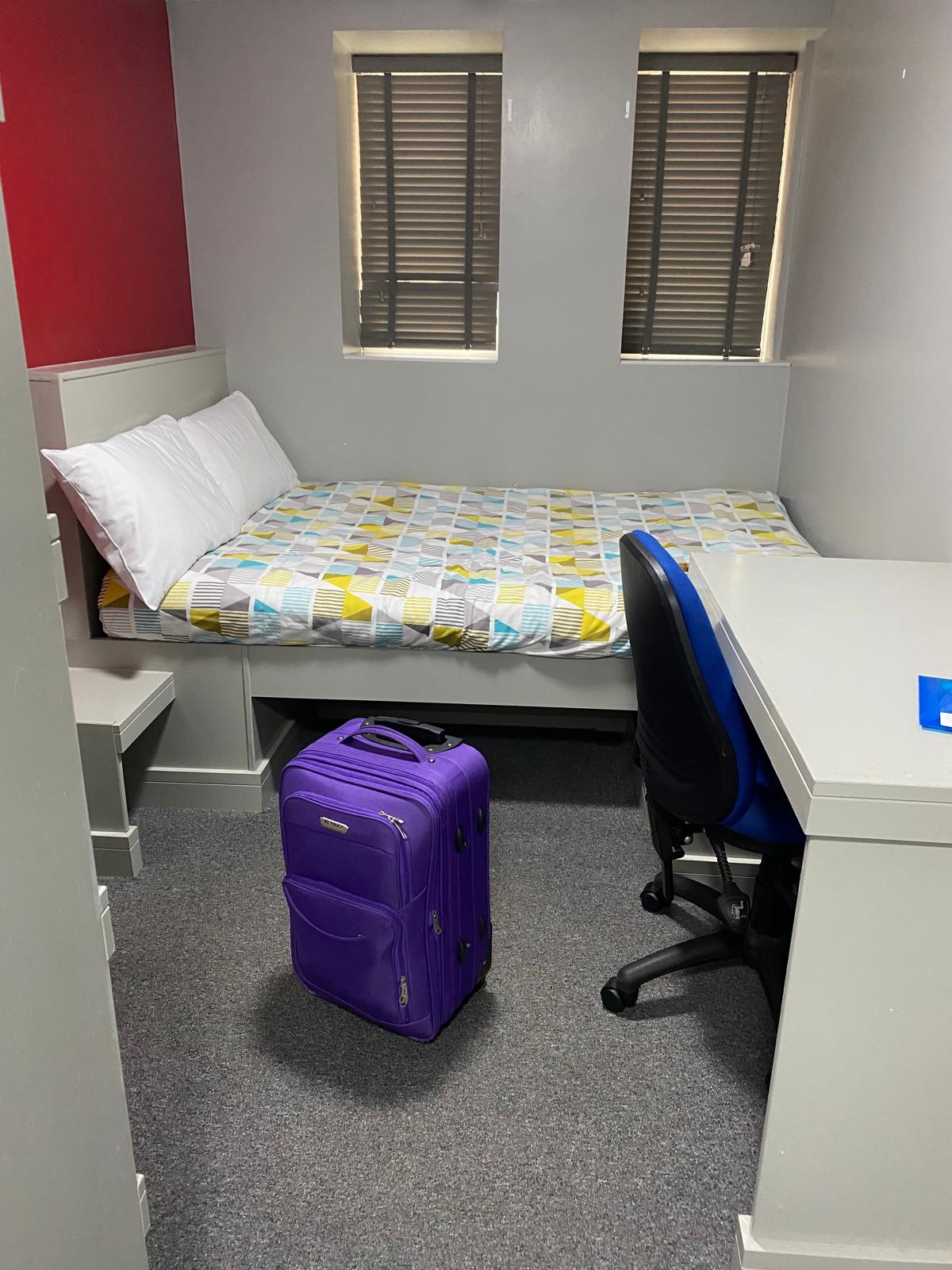
I didn’t get a photo of me talking at the event, but the first photo at the start of this blog shows my student accommodation for two sleeps which was lovely this time round as it had a double bed. The second is my half-eaten lunch at the event with the extremely classy York St John napkin. My work was part of the post-grad celebration not because it is of any particular merit yet, but writing it did lead to quite a lot of creativity. Experimenting with many of the techniques I identified, I wrote and subbed several flash fictions and micros, one of which is already shortlisted in a fab comp and which will therefore be published and for which I will get paid, so success of a kind. More deets next time when said flash is actually out in the world.


 Jan Kaneen Creative and Other Writing