
This is all new then. I’m in York for the first time as part of my PhD studies. I came up on Wednesday and am leaving this evening (Friday). I have been to York before as a tourist but this is my first time here at the Uni, staying in halls of residence and using university study facilities. I’m writing this on campus in the Research Centre which is a second floor space just for postgrads, that’s full of big computers and around 20 work stations, an attached break-out room and also a kitchen area where you can microwave lunch or pour hot water on your noodles. It’s very different from my usual writing space (tiny, built from stone with a sedum roof and heated by a wood burner). It’s all plexiglass windows and plastic work surfaces but it feels like somewhere I will get loads done.
I decided to visit right here, right now, because one of my facilitators puts on an annual editors/agents event for postgrad creative writers, and it was yesterday. One of this year’s 4 editors/agents was to be Dan Coxon who writes dark and short and whose work I much admire. As I was planning to visit my Ossett friend Clarey this (bank holiday) weekend anyway, and Ossett is, like York, in Yorkshire, now seemed an optimum time to come.
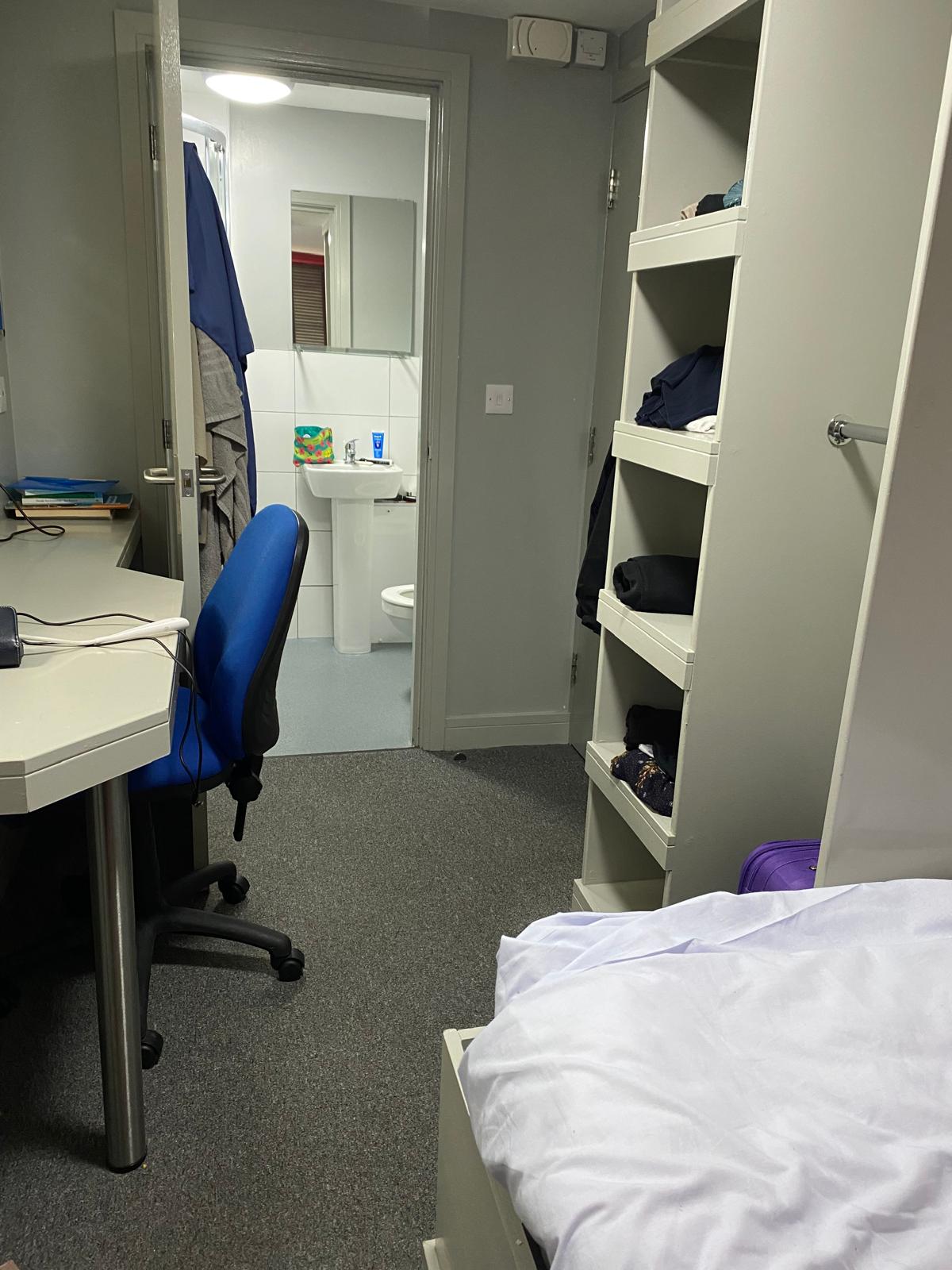
I decided to travel by train as Clarey said she would pick me up at her end on Friday (to) night. This was unfortunate as, as I was sitting on the first train at Huntingdon Station, the Tannoy announced that all trains were cancelled for the foreseeable, and could passengers please disembark. Turned out some poor soul had fallen under a train at Stevenage and all services were suspended. My husband who’d just dropped me off, came back, saying he would deposit me at the first station that the internet said was working, reasoning that stations further north would be unaffected. Sadly for my husband this turned out to be two hours drive away at Doncaster. I finally arrived in York at five pm. The half-hour walk from the station to the porter’s lodge was lovely despite dragging a wonkily be-wheeled suitcase, taking me as it did past the ancient city walls in sight of the towering Minster. The porter’s lodge was easy to find as was the very nearby, accommodation. After a little difficulty with the front door key, (which was sorted out by a kind resident), I made myself at home in my tiny room. Golly student accommodation has come on since my undergrad days. All ensuite and WiFi’d up with a huge shared kitchen. Here’s a photo of my tiny but comfy room.
The meeting with Dan Coxon on Thursday was affirming and positive, and I was gratified to hear that what he had to say about indie publishing and the journey of a nonconformist writer is mirrored by my own experiences. This made me feel that what I’m doing is going in the right direction. I gave him a copy of my dark collection of short and very short stories, Hostile Environments, which I hope he had a look at on his train journey home. The evening panel also compounded my own experience and made me feel like I’m on the right track.
Today, after I’ve finished this blog I’m going to continue my new project – writing a Flash Manifesto. To explain. Previous readers of this blog might remember I’d been trying to edit a short story I wrote a couple of years ago into becoming a short story ‘in-flash’ i.e. a short story comprised of standalone flash fictions. I was doing this as an experiment to better see the mechanics of ‘in-flash’ writing. But since I last blogged, I’ve come up against loads of problems/struggles in the doing of this, the first of which has been describing flash fiction as a distinct writing form in itself, let alone what writing ‘in-flash’ might be.
The more I study flash, the more I believe it’s a form that hates definition, and that it’s more of an umbrella term than a single describable form with consistent characteristics. Longer flash fictions, for example which to my mind can only be up to 1000 words (though there is no agreement on this and very often litzines ask for flash up to 1500 words) anyway, longer flash fictions up to 1000 words, are often more like short stories with narrative arcs and protags who undergo change and moments of epiphany. Mid-size flashes of 500 words or so, are often more about a moment – still with narrative arcs or movement but on a temporally smaller scale – often but not exclusively… One of my own prize-winning 500 word flashes for example, covers 10,000 years! You see nothing is a given in flash. But quite often mid-sized flashes present a narrative moment in a short-story-esque way. Micros however, (which I’m saying are flashes of 300 words and under) depend heavily on subtext, relying on readers to ‘join dots’, to have insight and cultural pre-knowledge about themes and issues, thus allowing writers to leave so much unsaid. And drabbles, (micros of exactly 100 words) always rely on unspoken subtext and charged signifiers. There seems to be something of quantum physics with flashes the smaller they get. Micros with all that omission and subtext seem to operate like entangled particles do in the weird quantum world were particles that are separated by time and space are somehow inexplicably linked or entangled. Similarly the loaded words inside micros set off ripples of change in readers’ minds so each reader constructs their own, bespoke interpretation/narrative/story, drawing on their own particular life experiences, experiences that might have happened decades or minutes ago and every-when in between, allowing them to make/intuit/construct narrative connections as they read inside, around and through as well as between the lines. Chuck into this mix, the overlap between prose poetry and flash, and even poetry itself (must micro flash tell a story or provide a context in which a story might happen or can it just present words wherein attuned readers might or might not intuit intended narrative happenings) and you have quite the gordian knot of possibilities as to what flash fiction might be/encompass.
A week ago I shared all this with my supervisors, also pointing out the virtual non-existence of scholarly texts on the subject that I might refer to, and they suggested writing a flash manifesto, according to me. That I can use as a yardstick when rewriting my short story into a short story ‘in-flash’. I thought this was a genius idea, so now I’m writing what I think flash in all its guises, is, using my practitioner experience (having written over 300 published pieces of flash of all lengths) and having read (now) several how-to practitioner guides such as Rose Metal Press’s Field Guide to Writing Flash Fiction, Randall Brown’s A Pocket Guide to Flash Fiction and Nancy Stohlman’s, Going Short, an Invitation to Flash Fiction.
When I have written, Jan’s Manifesto of Flash I will then describe converting my short story, Where the Truth Lies, into a short story ‘in-flash’.
I may, dear reader, be gone some time.


